
The Foundational Science
Jan 31, 2026
Why Most Microbiome Tests Fail Over Time

The Problem with Snapshot Diagnostics
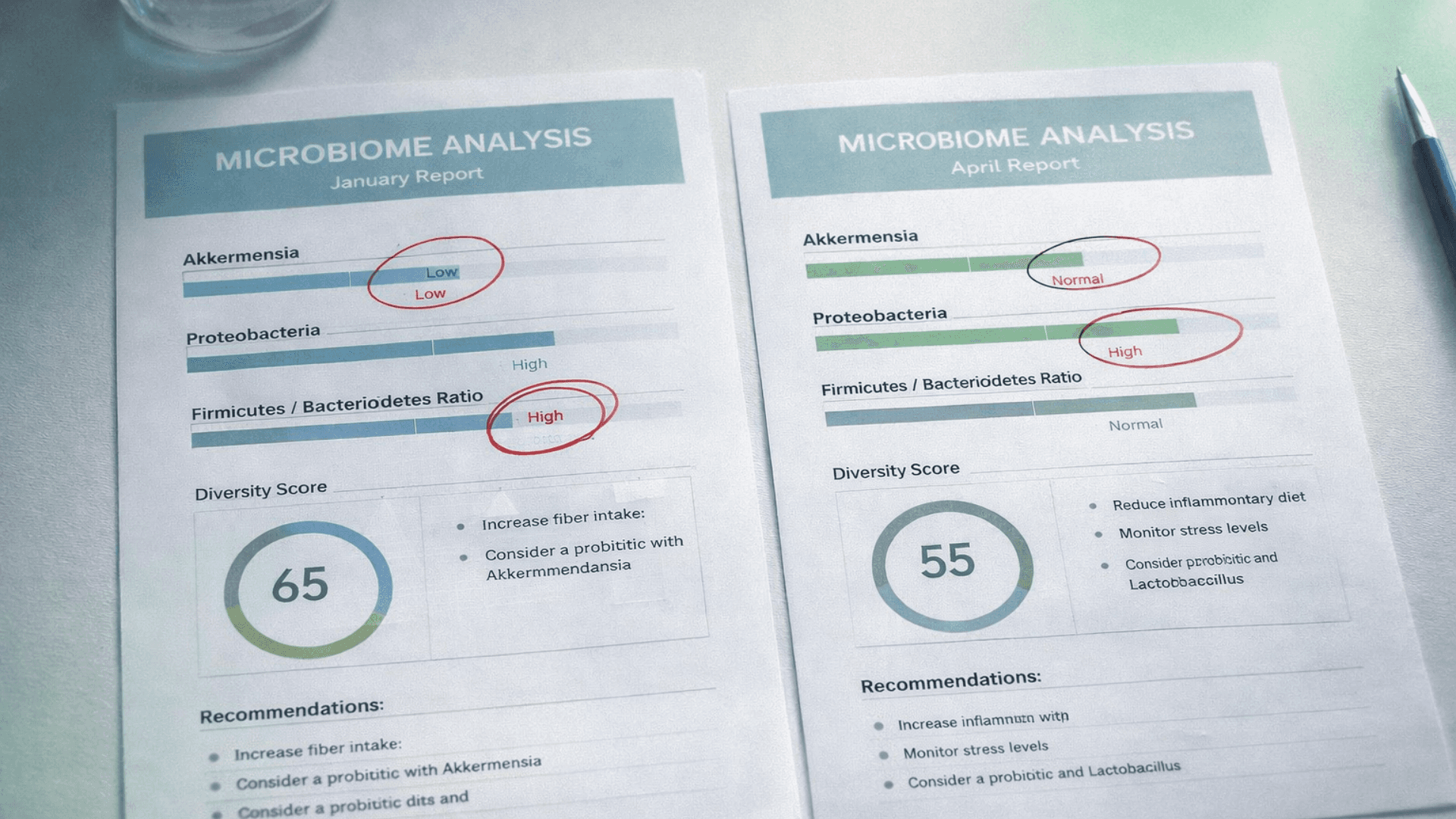
You ordered a microbiome test in January. The results came back: low Akkermansia, high Firmicutes-to-Bacteroidetes ratio, moderate diversity. You made dietary changes, took the recommended probiotics, and felt better.
Three months later, curious about your progress, you tested again with the same company.
The results were completely different.
What changed—your gut, or the reliability of the test?
If this feels familiar, you're not alone. The problem is not that microbiome science is flawed. The problem is how it is being applied.
Most microbiome testing today relies on snapshot diagnostics—single time-point measurements used to interpret a biological system that is constantly changing.
This gap between static testing and dynamic biology has real consequences: money spent on unnecessary supplements, confusion when results contradict previous tests, and worst—missed opportunities to identify meaningful health changes.
Let's examine why this matters.
The Snapshot Problem
Why Single-Sample Testing Cannot Capture Dynamic Biology
Most microbiome tests follow a simple structure: 1. Collect a stool sample 2. Sequence the DNA 3. Generate a report 4. Make recommendations
It's clean. It's scalable. But biologically, it's incomplete.
1. Your Microbiome Isn't Static—It's a Living Ecosystem
Your gut microbiome responds dynamically to: • What you ate yesterday • Stress levels and cortisol • Sleep and circadian rhythms • Medications • Physical activity • Even time of day
Without repeated measurement, you cannot distinguish: • A stable trait • A temporary fluctuation • A sampling artifact • A meaningful shift One test cannot tell you which is which.
2. Biological Variability Is Massive
Research shows intra-individual variability (how much YOUR microbiome changes) can rival inter-individual variability (how different you are from others). In practical terms: The difference between your microbiome on Monday and Friday may approach the difference between you and someone else.
Without repeated measurement, you cannot distinguish: • A stable trait • A temporary fluctuation • A sampling artifact • A meaningful shift One test cannot tell you which is which.
3. Technical Variability Adds Noise
Even if biology were stable (it isn't), sample handling introduces variability: • Stool consistency alters composition • Sampling location within stool differs • Shipping and storage affect DNA • Environmental contamination influences signal
Technical variability alone can account for 20–30% of observed differences between repeated samples. Combined with biological fluctuation, this creates a signal-to-noise problem that single measurements cannot solve.

Why Microbiome Test Results Change Over Time
Cross-Sectional vs Longitudinal Thinking
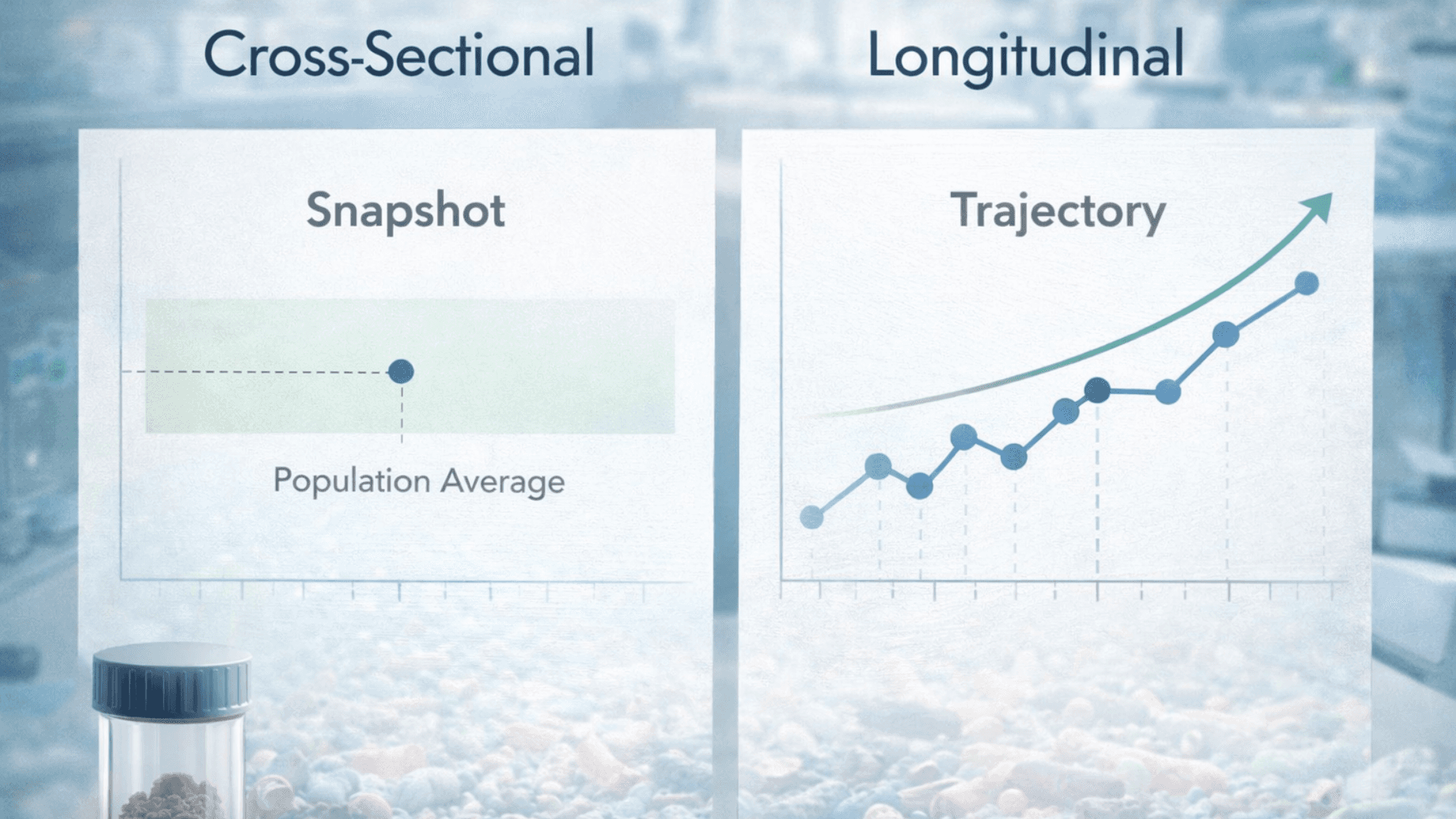
Most commercial microbiome tests are cross-sectional: • One time point • Compared to population averages • Deviation interpreted as abnormal • Recommendations based on a single reading But nearly everything we know about the microbiome comes from longitudinal studies—repeated measurements over time. This distinction matters because it affects how your results are interpreted.
Longitudinal analysis:
• Tracks YOUR baseline • Identifies trends • Separates signal from noise • Distinguishes acute response from chronic pattern • Interprets trajectory, not just position Biology unfolds over time. Interpretation must do the same.
The "Optimal Range" Illusion
Many reports use phrases like: "Below optimal." "In the 60th percentile." "Elevated ratio." But this approach contains structural weaknesses. • There Is No Universal Optimal Microbiome Two individuals can have entirely different microbial compositions and both be healthy. Function matters more than composition. • Population Averages Are Not Personal Targets Reference ranges are often derived from limited datasets. Being average does not mean being optimal for you. • Correlation Is Not Causation Associations between certain microbes and disease do not prove that changing abundance will change outcomes. • Complex systems do not behave linearly. Altering one variable rarely produces predictable results.
When Recommendations Backfire
Single-sample recommendations can mislead in subtle ways. You may: • Treat temporary variability (your low Bifidobacteria was stress-related, not chronic) • Optimize for a state that is already shifting (interventions lag behind biological reality) • Disrupt compensatory balance (the system self-regulates in ways testing doesn't capture) Biological systems self-regulate. Without understanding dynamics, interventions may oversimplify complexity.
What Actually Works
Systems-Based, Longitudinal Modeling
If snapshot testing is limited, what is required?
Systems-based, longitudinal modeling.
This includes: • Establishing personal baseline variability • Tracking trends over time • Modeling functional capacity, not just species counts • Interpreting biology in context • Making decisions based on trajectory This is how microbiome science is conducted in research. This is how clinical trials evaluate change. This is how complex systems are understood.
Timeline matters:
Real microbiome change occurs over weeks to months, not days. Meaningful interpretation requires patience and repeated measurement.

How to Choose a Reliable Gut Health Test
The Structural Gap in Current Testing
The technology to do this right exists: • High-resolution sequencing • Computational modeling • Multi-omic integration • Large-scale data processing
What remains underdeveloped is the shift from static testing to dynamic interpretation. From reports to models. From scores to trajectories. From snapshots to longitudinal intelligence.
What This Means for You
If you're considering microbiome testing, you should demand:
✓ Multiple time-point measurement protocols ✓ Transparent methodology (test-retest reliability, reference population details) ✓ Trend-based interpretation (not just deviation from average) ✓ Functional analysis (metabolic pathways, not just species lists) ✓ Honest communication of uncertainty You don't need to accept inadequate testing. Demanding longitudinal data is not unreasonable—it's scientifically necessary.
The Bottom Line
Your microbiome is not a photograph. It is a moving system. Single measurements cannot reliably capture direction, stability, or resilience. If interpretation does not account for time, variability, and system dynamics, it risks oversimplification. Biology deserves better modeling. And health deserves better tools.
This is why we're building Neogenetix Biopharma—to bring longitudinal microbiome analysis from research labs to everyday health monitoring. References 1. Faith, J.J., et al. (2013). The long-term stability of the human gut microbiome. Science. 2. Vandeputte, D., et al. (2017). Stool consistency is strongly associated with gut microbiome richness. Gut. 3. Mehta, R.S., et al. (2018). Stability of the human faecal microbiome in a cohort of adult men. Nature Microbiology. 4- Schloss, P.D. (2018). Identifying and overcoming threats to reproducibility. mBio. 5. Gilbert, J.A., et al. (2018). Current understanding of the human microbiome. Nature Medicine.